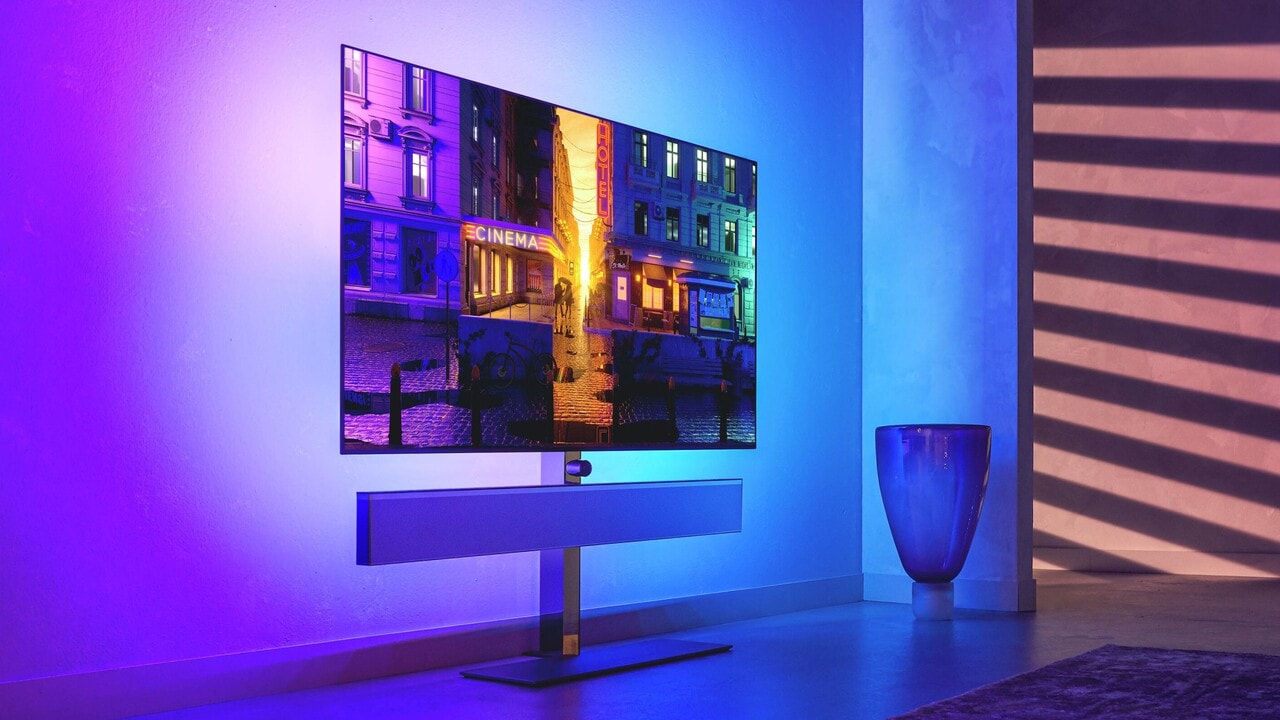
While is true that OLED technology offers unparalleled image quality, its brightness levels are not exactly spectacular. Samsung has promised that its QD-OLED TVs will reach peaks of 1000 nits without any problem, but until we test its long-awaited range of Smart OLED TVs, we will have to cross our fingers.
And it is that, when using an OLED television in a bright environment, the experience leaves a lot to be desired. The reflections make an appearance making watching a movie, series or any other content without closing the curtains is a problem.
Although it seems that sooner rather than later this problem will have a solution. All thanks to the joint work being carried out by the Korea Advanced Institute of Science and Technology (KAIST) and the Electronics and Telecommunications Research Institute (ETRI), who have just announced that they have been able to develop an innovative material that It will allow to improve the luminous efficiency of OLED and QLED screens.
It may interest you: Are you looking for deals on OLED TVs? 65″ Panasonic HZ1000 for 1,399 euros at Mi Electro
OLED TVs of the future will be brighter than ever
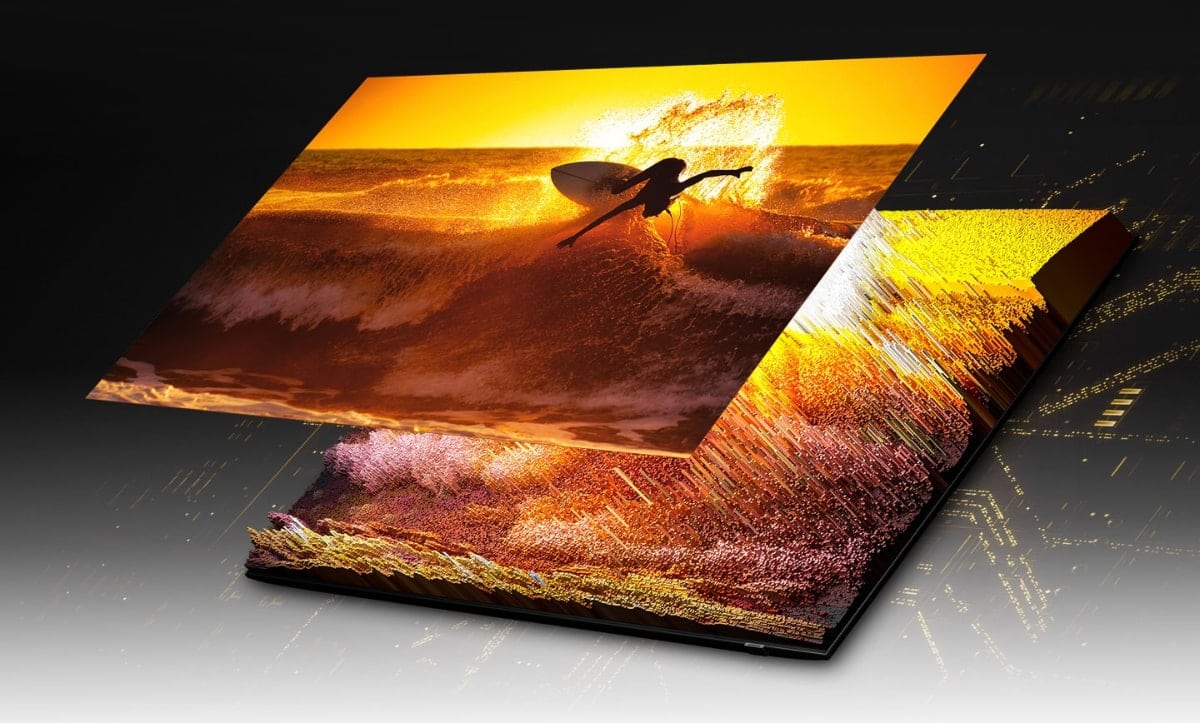
Their work, which has been published in the prestigious journal Nature Communications, explains that the team discovered that the nanometer-scale dispersion of metal oxide nanoparticles in another oxide causes a charge exchange at the contact surface. Y When testing it on OLED and QLED screens, they saw that the brightness level was significantly improved.
This new material, which takes advantage of metal oxides to offer charge transfer with different energy levels It has a very simple system. The structure itself can be loaded with more metal oxide nanoparticles combined with other nickel and molybdenum oxide nanoparticles to improve electroconductivity efficiency, and further adjust brightness levels. Mainly, they tested it on green and blue OLEDs, achieving a 32% improvement in efficiency.
At the moment they are still testing this system to try to implement it in future generations of OLED devices, from smart TVs to laptops, so you will have to be patient.
Evidently, many tests will have to be done before Samsung and LG consider implementing this new technology in their production lines, but it is clear that more and more people are working to improve one of the few weak points that OLED technology has. And it seems that the forecasts that bet that televisions with this type of panel will be a regular in our homes from 2026 do not seem to be so far off the mark.
And this is excellent news for the user. Until now, the lack of brightness in OLED TVs has historically been their biggest Achilles’ heel, along with retention and burn-in problems. But with the advent of this new technology, this problem can be solved to achieve unquestionable image quality regardless of the environment.