We know that what we are going to comment on the report does not affect those of us who are immersed in this world of processors and graphics cards, but really that in itself is a fallacy. And it is because both components together with the others need precisely thousands of small chips such as capacitors, resistors and various controllers that are also chips. IDC puts white on black in a movement that only a few could intuit.
The reasons for the shortage of chips: a bad strategy that conditions everything

Although it seems obvious because it is the manufacturers that work with their demand, the strategy they followed was largely wrong. We always think that wafers at lower nanometers are the most demanded and it really is, but only partially. AMD, Intel and NVIDIA seek performance and thus the best node, but the rest of the industry needs other manufacturing processes that have a common argument: volume and price.
The pandemic began and all the actors focused on putting money hand over fist in the largest volume lithographic processes because the demand was focused on it. But this dragged everyone to a point of almost no return, because the strategy could not be based only on this, it was necessary to be foresight and be attentive to what was to come, but they did not do it and here comes the biggest problem according to IDC.
There was no investment for mature and economical processes
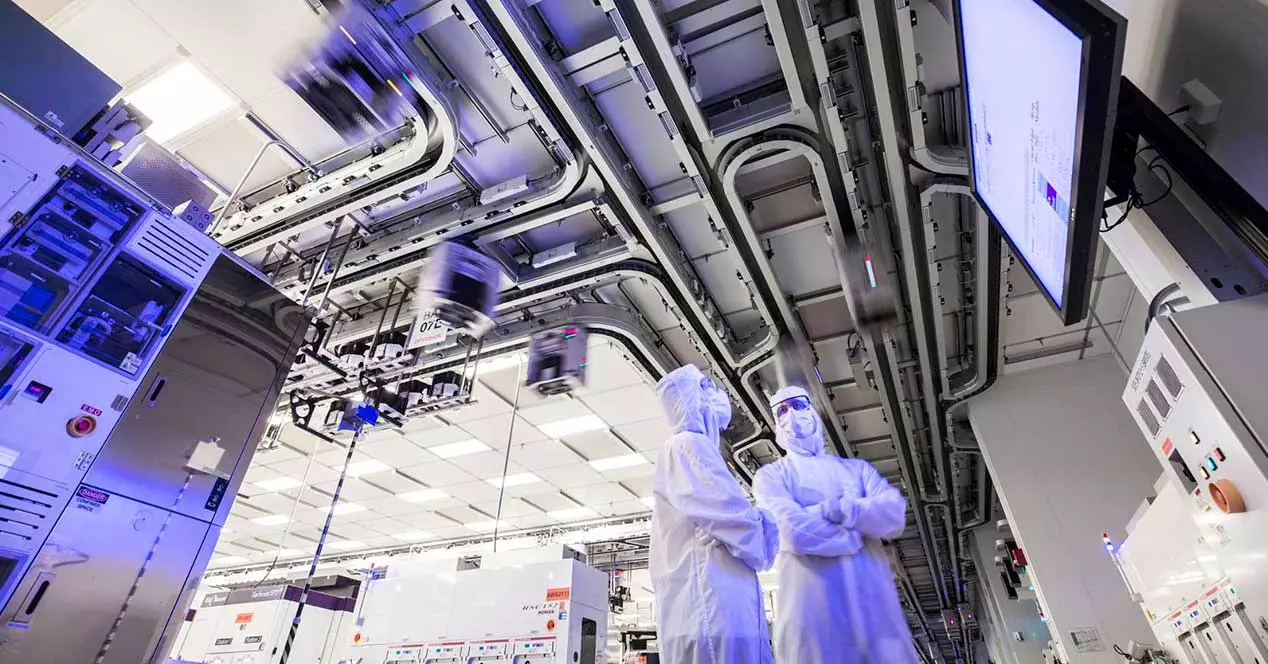
State-of-the-art processes pushed the rest of the industry to need 40nm or larger chips at unbelievably higher volumes because the three major players pushed the machinery to the limit. There were substrates, there were chips, but there was no auxiliary industry to support them with billion-dollar investments for the rest of the manufacturing processes that now needed to increase their productivity in greater proportions than Intel, Samsung and TSMC.
To be specific, IDC says that the 67% of semiconductors were produced using those mature processes during 2021 (immature processes are considered from the 16nm down), since state-of-the-art manufacturing is only 15% of wafers manufactured globally.
That fifteen% however, it represents in terms of income the 44% and for this reason, at the beginning of the semiconductor crisis, everyone turned to the most cutting-edge nodes, because they give a lot of profit, but they did not calculate either the investment or the blow that it would drag down with it to the rest of the industry. There was only one company, a foundry that, due to its situation, could not take this step and has subsequently benefited: Texas Instrumentswhich increased production in their nodes and had room to earn more by supplying what the others could not, until it reached its limit, of course.

The company has gained 19% compared to the quarter of last year. The solution to the problem will not come until at least 2025, when China and South Korea will go from 16% and 12% to 19% and 15% of the market thanks to the investments made today, while Taiwan goes from 67% to 68%. That is only in Asia, because data from Intel as such and from Texas, as well as GlobalFoundries have not been offered to have a global map of where the wafer and semiconductor market is headed.
In any case, the investment was done wrong, this is certainly one of the reasons for the shortage of chips because they simply focused on making more money in the short term and not thinking about the long term because by then they should have the ability to react to mitigate the blow, something that none of the participants has been able to do because, as they say, “Rome was not built in a day”.