First of all it is important to clarify that this GeForce RTX 060 Ti with ASUS SSD slot is, at least for now, just a proof of concept, not a device that is going to be marketed already. Which, on the other hand, is a shame, because the truth is that the proposal has many interesting points, so it may arouse special interest among many users who were already considering making the leap to the new generation of NVIDIA. Personally, if I were thinking about building a PC today, I have little doubt that it would seem like a more than recommendable option.
Having made this clarification, to avoid anyone getting their hopes up (at least ahead of time), today we can see in Wccftech that ASUS has shown a GeForce RTX 4060 Ti that incorporates a PCIe M.2 Gen 4 slot in which we can install a memory of this type, as you can see in the two images that illustrate this news. Specifically, for the test shown by ASUS, a 2 terabyte Samsung 980 PRO SSD was used, that is, this concept allows the mounting of any standard SSD, it is not an in-house development that only allows the mounting of specifically designed drives for this format. The graphics card, meanwhile, is a standard GeForce RTX 4060 Ti design.
There are several advantages that a system like this ASUS prototype would provide. The first that the brand wields is that allows the use of lanes not used by the GPU, thus optimizing the use of system resources. For this alone, I can imagine many users positively evaluating this proposal. Specifically, this GPU uses eight lanes, while an NVMe PCIe Gen 4 SSD uses four, so a hypothetical future design could accommodate two units of this type.
Another very interesting advantage of this ASUS proposal is that, as a general rule, access to the back of the graphics card is usually much easier than that referred to the PCIe slots. What’s more, in many assemblies it is necessary, precisely, to remove the graphics card to mount or unmount an NVMe drive. If ASUS goes ahead with this proposal and manages to commercialize it, this will translate into a greater simplicity to carry out this type of operations.
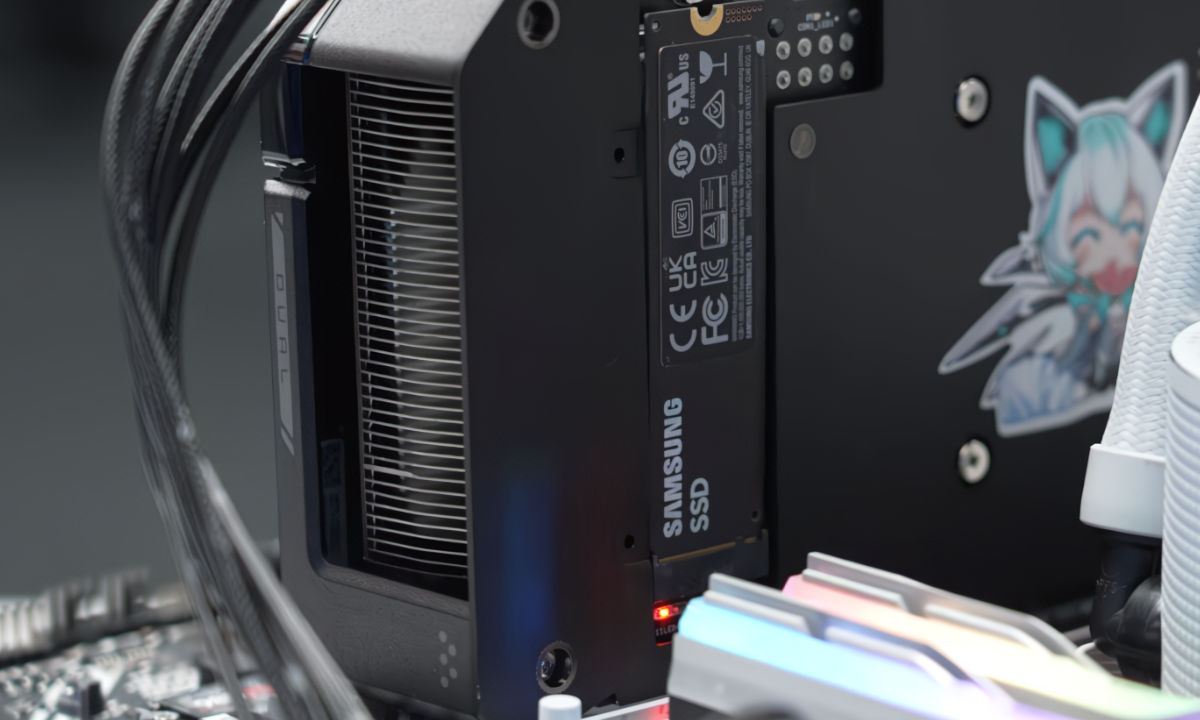
It does not seem, however, that this format translates into an improvement in performance, because even if both devices are “together”, the communication between them will be subject to the same conditions as if the SSD were connected independently. However, if in the future a way were found to exploit this interconnection in the context of games that use DirectStorage, perhaps we could see interesting improvements.
One aspect that can be worrying, yes, is the temperature. Obviously we are not talking about PCIe Gen 5 drives, in which thermal management begins to get complicated, but Gen 4 drives also generate heat that adds to that of the graphics card itself. To address this problem, ASUS has modified the design of the board and the dissipation elements, so that they also perform their function on the storage unit. The consequence of this? Well, initial tests revealed a 10 °C drop in the SSD’s temperature, compared to its temperature when mounted independently.
An interesting list of advantages, and few problems that have already been solved from the start, tell us that we are talking about a solution that has a lot of potential to reach the market. The key at that point will be, of course, if their price makes them competitive compared to a standard GeForce RTX 4060 Ti. If ASUS also scores that goal, we may be facing a technology with a great future ahead.