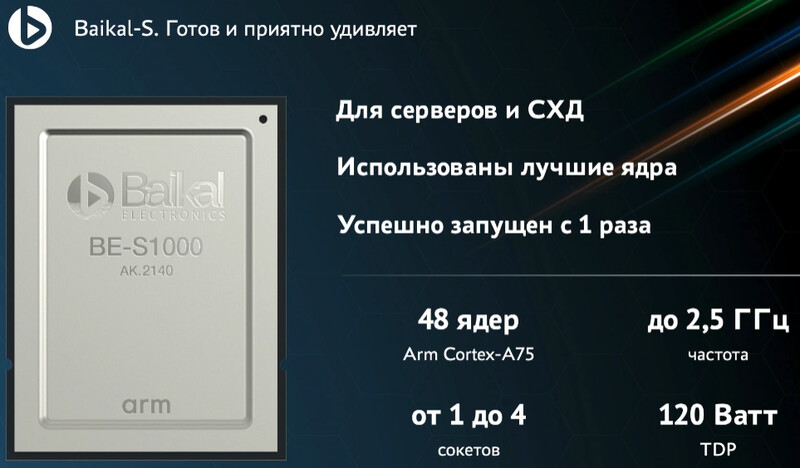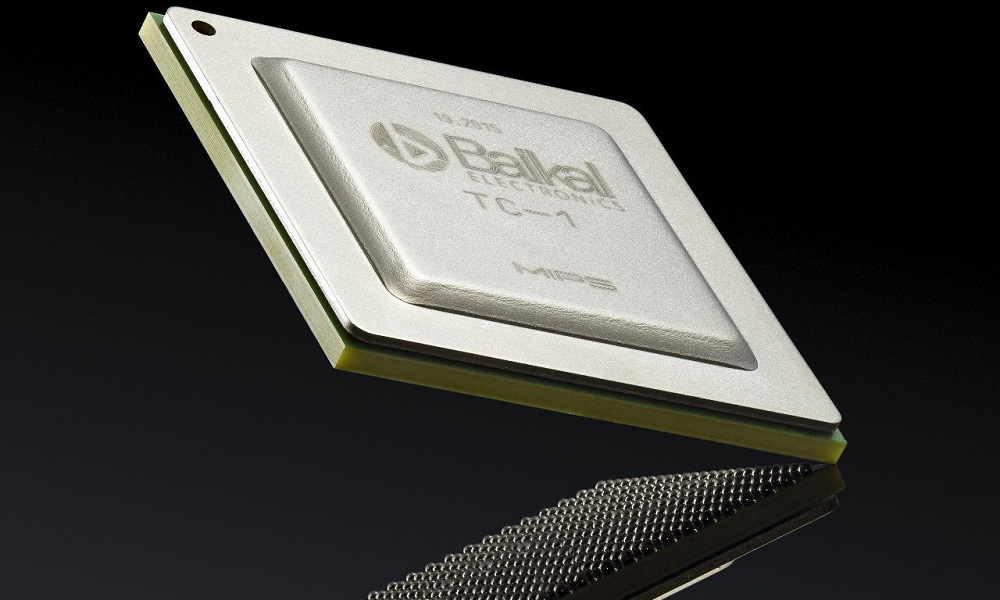
The Baikal-S is presented as a very interesting high-performance processor for servers, since it uses the ARM architecture, it is configured with a total of 48 cores, and has a RISC-V coprocessor which performs such important functions as safe boot and managing other key aspects of the chip. This means that it presents a totally personalized design, but it is also highly scalable.
Baikal Electronics has offered numerous details about the Baikal-S, and thanks to this we have been able to confirm that this chip has a base frequency of 2 GHz, although can reach 2.5 GHz thanks to turbo mode. Its TDP is 120 watts, a very good figure if we consider that it is a 48-core chip.
In terms of performance, the Baikal-S is at the level of an AMD EPYC 7351, a 16-core, 32-thread chip based on the 2.9 GHz Zen architecture, and according to the Russian company it is also comparable with the Intel Xeon Gold 6148, based on the Skylake architecture and equipped with 20 cores and 40 threads (working at 2.4 GHz), although it yields 15% less than the Huawei Kunpeng 920, something very curious since the latter also uses the ARM architecture, and has a 48-core configuration. This difference in performance is due, in theory, to the fact that the latter has a slightly higher frequency (2.6 GHz).

The Baikal-S uses Cortex-A75 cores, and can be integrated into configurations of up to four sockets, which means it can scale to a maximum configuration of 192 cores. The production of this chip has already begun, and it is expected that by 2022 it will reach 10,000 manufactured units, a figure that, in 2023, would amount to 30,000 units.
If we compare it with what other companies such as Intel or AMD currently have on the market, it is clear that the Baikal-S is in a clear inferior position, at least in terms of gross power, but it represents an important advance for the technology sector Russian (at the domestic level), and demonstrates, at the same time, the potential and versatility of ARM and RISC-V architectures. We won’t see implementations of the Baikal-S in the West, but it could serve as a spearhead for Russia to put future development of more advanced and locally competitive chips on track.