For AMD, the use of V-Cache technology, which consists of vertically connecting a SRAM memory chip to increase the amount of cache memory, has allowed it to create the Ryzen 5800X3D and in a few weeks we will have the Ryzen 7000 X3D. Well, everything indicates that graphics cards with this technology will soon be released. Is the Radeon RX 7000 X3D with vertical cache on the horizon?
One of the general trends in the architecture of new GPUs is to integrate a large last-level cache with the aim of reducing memory accesses and thus energy consumption. We first saw it in the AMD RX 6000 in the form of Infinity Cache, we later saw NVIDIA multiply the amount of cache sixteen times in its RTX 40 compared to the RTX 30 and this trend has continued with the AMD RX 7000. Of course, in the latter case cutting from 128 to 96 MB in the case of the RX 7900, but considerably increasing the bandwidth.
Are we going to see RX 7000 X3D cards with V-Cache soon?
We must take into account that in all processors, whether general or specific purpose, as is the case with the central chip of a graphics card. If you have a multilevel cache hierarchy, the one with the largest size is the last level and therefore closest to memory. That is why in Ryzen the addition of the V-Cache increases the amount of L3 and not L2 or L1.
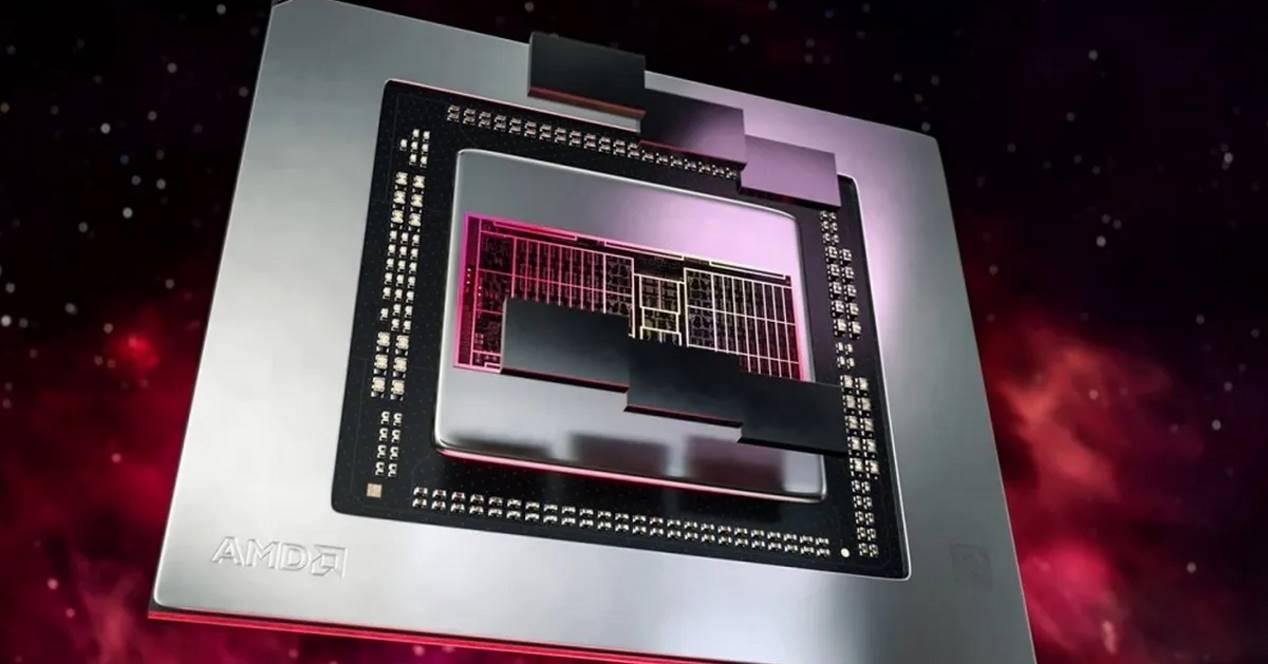
In GPUs based on RDNA 3 architecture and specifically under the Navi 31 chips, used in the RX 7900, and Navi 32, for the future RX 7800, AMD has decided to create a GPU split into several chips. On the one hand, the central chip which is the GCD and on the other several small chips called MCD. Well, the last level cache is in the latter, so the concept would be to place a V-Cache chip in each of the MCDs to increase the Infinity Cache amount.
At the moment we do not know the amount, a few months ago a rumor came out that we could see the capacity per graphics card doubled. That is to say, RX 7900 X3D is expected to have 192MB of V-Cache, but they are nothing more than leaks from a few months ago and AMD may have made last minute changes. The fact is that if they use the same chips as in the Ryzen, we would be talking about 480MB Infinity Cachebut we have to assume that the cache of a CPU and a GPU work something different and, therefore, everything indicates that it will not be the same.
How will it give more performance to our games?
The advantage of this is that this increases the chances that data is found before RAM, remember that accessing memory has a 10 times higher energy cost and higher latency. This allows the GPU to run at higher speeds without increasing power consumption, however this is not the only reason for this as there are added benefits to having a large cache.

The current AMD and NVIDIA cards work almost like a renderer for tiles, but with a difference, instead of using a local memory to save the blocks of the image buffer, they use the cache. So if there is not enough space, older data is dumped in VRAM and performance is lost. However, it is not the only advantage facing the games.
We have to start from the fact that many titles today use post-processing effects, that is, they are applied to the already existing image buffer and the ideal for certain operations is to have the data in a memory close to the processor. The other reason has to do with the data structure for Ray Tracing, the BVH tree. Having it without having it in memory is a major performance improvement for ray tracing.
The secret weapon to beat the RTX 40
Artificial intelligence is one of the issues that has been ignored by AMD in recent years and in which they are putting their batteries. An example is the addition of an NPU in their Ryzen 7000 for laptops and the ability under the RDNA 3 architecture to emulate tensor-type units. What is clear is that AMD is not going to modify the GCD of its RX 7000.


And what do the RX 7000 X3D graphics cards have to do with AI? Easy, a while ago AMD patented the concept of using V-Cache based chiplets and accelerators for AI. It described a central chip with the Compute Units and then a series of satellite chips with the last level cache that also integrated accelerators for Machine Learning. Does this setup sound familiar to you? Also, it would include the ability to convert part of the memory to local RAM instead of working as a cache, allowing AMD GPUs to convert a full tiled renderer.