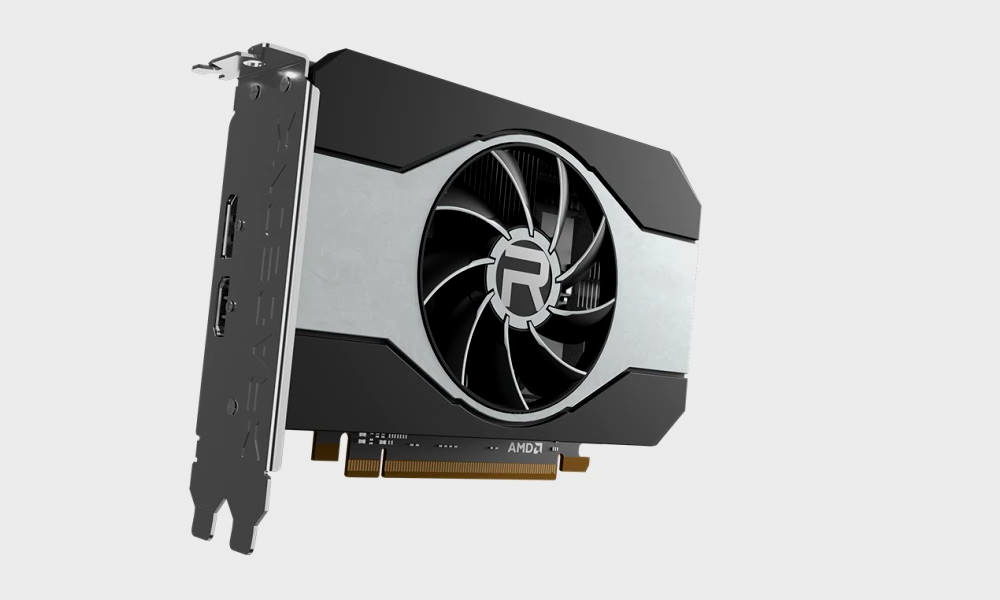
Today was the big day, AMD has launched the Radeon RX 6500 XT, a budget mid-range graphics card that, as we told you at the time, generated great interest because it was going to become the closest direct equivalent to the GPU of Xbox Series S, although said graphics card I had everything to be more powerful, despite the difference in active computing units.
In the end, there has been no surprise. The Radeon RX 6500 XT It has fulfilled all the expectations that it had generated, and has also confirmed the bad omens that arose after knowing that it was going to use a PCIE Gen4 x4 interface, and that is, as happened with the Radeon RX 6600 and Radeon RX 6600 XT, both limited to PCIE Gen4 x8, when used with a PCIE Gen3 motherboard, there is a noticeable performance loss. We will talk about it later, but we already told you about it in our analysis of the Radeon RX 6600.
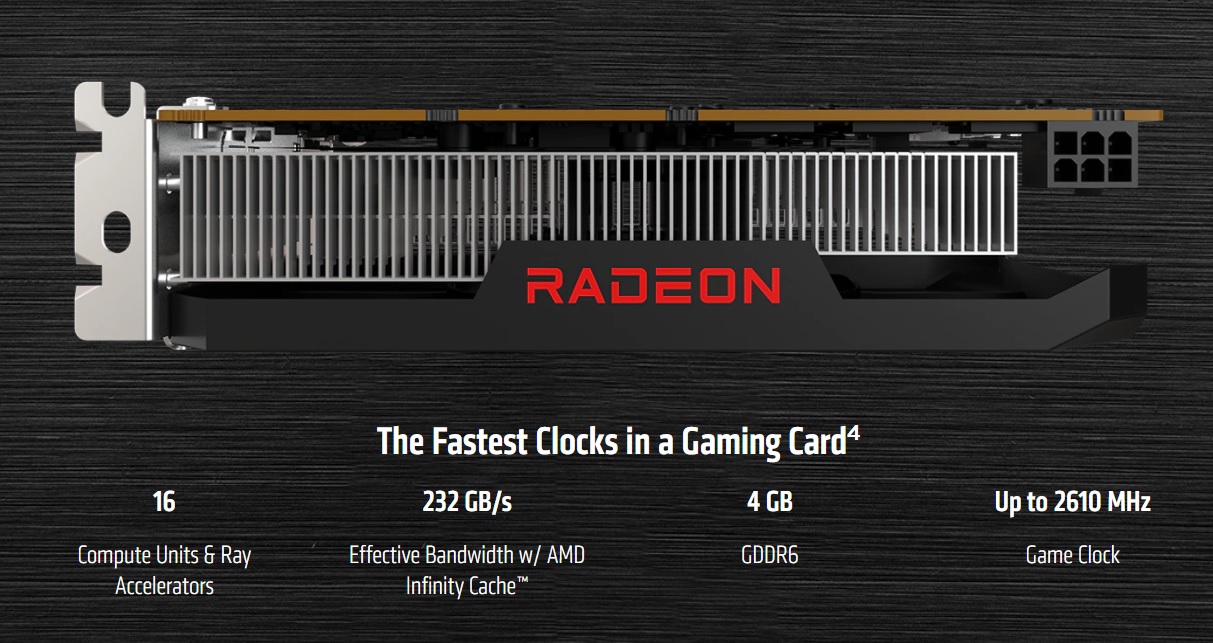
The first units of the Radeon RX 6500 XT that we have seen have a careful design and a fairly good build quality, so much so that in some cases it is hard to believe that we are dealing with an economic mid-range model. Regarding its specifications, nothing has changed compared to the information we gave you in recent weeks. These are its characteristics:
- Navi 24 XT GPU at 6nm.
- 1,024 shaders at 2.2GHz-2.81GHz, normal and turbo mode.
- 16 ray tracing acceleration units.
- 64 texturing units.
- 32 raster units.
- 2610MHz-2815MHz GPU frequency, normal and turbo mode.
- 16MB infinite cache.
- 64-bit bus.
- 4GB of GDDR6 at 18GHz.
- FP32 power: 5.76 TFLOPs.
- Bandwidth: 144GB/s.
- 107 watt TBP.
Radeon RX 6500 XT performance: how do you position the new AMD?
TechPowerUP! has published one of the best reviews we have had the opportunity to read so far, so I am going to share with you the most important information that we can extract from it. In 1080p resolution, the Radeon RX 6500 XT stands almost on the same level as a GTX 1650 Super, a graphics card that was mid-range at the time. This tells us that AMD’s solution can with current games in 1080p, but in the most demanding cases we will not be able to always configure them to the maximum if we want to enjoy a good fluidity.
Cyberpunk 2077 is a good example, as it averages 26 FPS in 1080p and maximum quality, although being fair too there are other less demanding titles that work perfectly in 1080p and maximum quality on the Radeon RX 6500 XT, like Resident Evil Village, Death Stranding and DOOM Eternal, for example. Those games also run very well at 1440p, a resolution that’s a bit too big for the Radeon RX 6500 XT, though.e this does not mean that it is not a viable option if we adjust the level of graphic quality. All in all, said graphics card gives its best in 1080p, and that is its optimal level, without a doubt.
Of the 4K we forget directly, of course, although pulling FSR we could get acceptable performance results in some cases. When it comes to their high resolution equivalents, we see the Radeon RX 6500 XT trailing the GTX 1650 Super at 1440p, and trailing the RX 570 when we step up to 4K. That performance drop as the resolution goes up is a consequence of the Radeon RX 6500 XT’s design, which uses 16 MB of L3 cache to compensate for its low bandwidth.
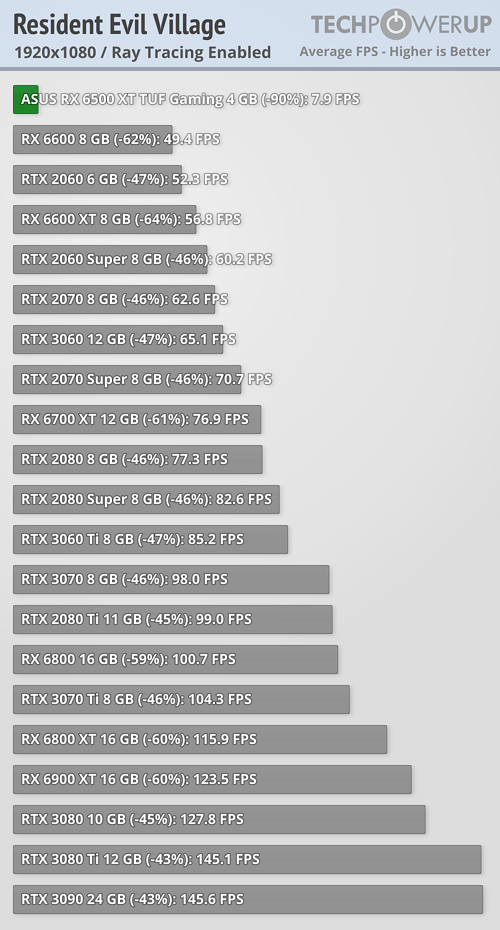
In ray tracing, the Radeon RX 6500 XT achieves some surprising results because it manages to outperform, in some cases, even the Radeon RX 6600 XT, at least according to the data collected by the source of the analysis, although in general its performance with said technology is very poor and it ranks, with few (and rare) exceptions, well below the RX 6600. For example, in Deathloop the Radeon RX 6500 XT achieves an average of 13 FPS, while the Radeon RX 6600 achieves 43.4 FPS (1080p ).
The Radeon RX 6500 XT is not a graphics card with high consumption, in fact in the tests of TechPowerUP! was around 101-112 watts, but despite this the working temperature reached a bit high, since with the standard BIOS it reached 72 degrees, and with the fans in low noise level it went up to the 80 degrees.
If we use the Radeon RX 6500 XT on a motherboard that is limited to PCIE Gen3, performance is reduced, on average, by 13% under 1080p and 1440p resolution, and 18% in 4K. Things would be even worse if we connected it to a PCIE Gen2 slot, since the performance loss would be 34% in 1080p, 29% in 1440p and 45% in 4K.
Final Notes: The Radeon RX 6500 XT Is What We Expected, But Not What It Should Be
As I said at the beginning of the article, the Radeon RX 6500 XT has strictly met all our expectations because it fully matches the leaks that we have been seeing, but unfortunately it is not up to what we would have liked, and is not what it should be, that is, It is not that successor to the Radeon RX 5500 XT that we all expected.
I don’t speak for no reason. It is true that the Radeon RX 6500 XT uses a more advanced architecture, and that it has hardware dedicated to ray tracing, but its performance is lower than that of a Radeon RX 5500 XT of 4 GB (the difference is small in 1080p, but considerable in 1440p), it has a significant lack derived from the use of a PCIE Gen4 x4 interface and it also comes without AV1 hardware decoding.
If we put all of the above together, and add it to its poor ray tracing performance, we realize that the Radeon RX 6500 XT has nothing that makes it worthy of being the successor to the Radeon RX 5500 XT. Its recommended price is 215 euros, but I am afraid that, due to the inflation that the graphic sector is experiencing, it will be impossible to get it for that money. However, if you can find it for less than 250 euros, and you urgently need to update your graphics card, it wouldn’t be a bad buy, especially due to the current situation in the sector.