After a long wait, AMD has finally given us the details of the first models of its Ryzen 7000, as well as information on its performance compared to the previous generation, clock speeds, configurations and prices. Let’s see how the first CPUs under Zen 4 architecture for desktop computers
While Intel has decided to bet on the use of a heterogeneous configuration in terms of the different processor cores. AMD, on the other hand, is much more conservative with its Ryzen 7000, playing it safe and giving each of them the same performance. It could be said that they have opted for a CPU with only P-Cores, an intelligent decision that we are sure will give them the crown as the most powerful processor of the moment. Unless, of course, Intel does not give an unexpected surprise with its Intel Core 13.
First models, specifications and price of the AMD Ryzen 7000
AMD has presented the first four models that will be part of its range of Ryzen 7000 desktop processors, whose specifications are as follows:
- At the top of the range we have the Ryzen 9 7950X, with a price close to 700 euros and a 16-core, 32-thread configuration. Its base clock speed is 4.5GHzbut can reach a speed of 5.7GHz via Boost with a 170W TDP
- Second, and around 550 euros, we have the Ryzen 9 7900X with a 4.7 GHz base speed and a Boost of 5.6GHz, also under a 170W TDP. Although with a setting of 12 cores and 24 threads.
- The AMD Ryzen 7 7700X uses a different configuration, since it uses one CCD chip instead of two, which is why its TDP drops to the usual ones in AMD processors 105W. Your clock speed? 4.5 GHz with a maximum of 5.4 GHz. Its price? Around 400 euros.
- And in the most modest place we have the AMD Ryzen 5 7600Xwith a setting of 6 cores and 12 threads running running at 4.7GHzbut with the ability to reach the 5.3GHz and with a price close to 300 euros.
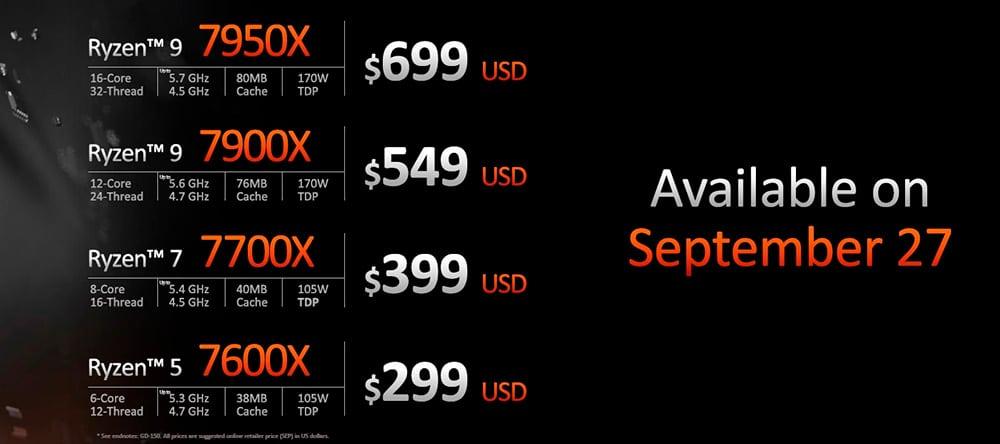
The performance keys in the Ryzen 7000 are two, on the one hand, one improved architecture which according to its creators results in an average of additional performance per clock cycle. On the other hand, this parameter has also been improved compared to the Ryzen 5000, the previous range of AMD CPUs for desktop computers that appeared at the end of 2020. As for the launch date of the new AMD processor, this will be next September 27.
How do they compare to the previous generation?
With an Intel having regained the leadership in terms of performance with the Intel Core 12 and its Alder Lake architecture and the refinement of these in the form of the next generation of processors, AMD could not only improve the architecture to increase performance, but which have also made the frequencies that the new Ryzen 7000 can reach much higher than those of their direct predecessors with equal cores, which were the desktop Ryzen 5000 based on Zen 3 architecture.
| Processor | Cores/Threads | Base Frequency | Maximum Frequency | Cache (L2+L3) | TDP |
|---|---|---|---|---|---|
| ProcessorAMD Ryzen 9 7950X | Cores/Threads16/32 | Base Frequency4.5GHz | Maximum Frequency5.7GHz | Cache (L2+L3)80MB | TDP170W |
| ProcessorAMD Ryzen 9 5950X | Cores/Threads16/32 | Base Frequency3.4GHz | Maximum Frequency4.9GHz | Cache (L2+L3)72MB | TDP105W |
| ProcessorAMD Ryzen 9 7900X | Cores/Threads12/24 | Base Frequency4.7GHz | Maximum Frequency5.6GHz | Cache (L2+L3)76MB | TDP170W |
| ProcessorAMD Ryzen 9 5900X | Cores/Threads12/24 | Base Frequency3.7GHz | Maximum Frequency4.8GHz | Cache (L2+L3)70MB | TDP105W |
| ProcessorAMD Ryzen 7 7700X | Cores/Threads8/16 | Base Frequency4.5GHz | Maximum Frequency5.4GHz | Cache (L2+L3)40MB | TDP105W |
| ProcessorAMD Ryzen 7 5800X | Cores/Threads8/16 | Base Frequency3.8GHz | Maximum Frequency4.7GHz | Cache (L2+L3)36MB | TDP105W |
| ProcessorAMD Ryzen 5 7600X | Cores/Threads6/12 | Base Frequency4.7GHz | Maximum Frequency5.3GHz | Cache (L2+L3)36MB | TDP105W |
| ProcessorAMD Ryzen 5 5600X | Cores/Threads6/12 | Base Frequency3.7GHz | Maximum Frequency4.6GHz | Cache (L2+L3)35MB | TDP65W |
In addition, one of the things that stands out the most is that despite the fact that AMD has made the new chips consume much more than the previous ones, its performance per watt has risen 37% on average compared to the previous generation. Although the most daring on the part of Mark Papermaster, the technical director or CTO of AMD is that we are going to see a 74% increase in power compared to models with a TDP of 65 W of the Ryzen 5000. At the moment AMD has not presented these models, although tEverything points out that we will see them in early 2023 if they don’t advance them a few months.

And with Intel processors?
Compared to the Intel Core i9-12900K, the AMD Ryzen 7950X outperforms it in the following points:
- eleven% of additional performance compared core by core.
- 44% in tasks that require the use of multiple cores.
- 47% as far as performance per watt it means.
Let’s not forget that these figures are partial from the moment they were given by the company that designed these processors. So we will have to wait for more objective tests and without a partial interest. It is also worth remembering that the rivals in the Ryzen 7000 market will be the Intel Core 13 based on Raptor Lake architecture.
Improvements in the architecture of the Ryzen 7000
The increase in frequencies and performance in the new AMD CPUs has been made possible by the following factors:
- Adoption of TSMC 5nm Manufacturing Node for CCD Chipletswhich has allowed AMD to work with 58% more transistors.
- For the IOD 6nm has been adopted. This is the first time that AMD has completely revamped the IOD since the launch of the Ryzen 3000 with Zen 2. Adding in the process support for DDR5 memory and PCI Express 5.0.
- From AMD they have also renewed the structure and internal organization of their chips, which is known as architecture. All this to win a 13% additional power on average per clock cycle. Said internal renewal is what also allows the processor to reach higher clock speeds than the Ryzen 5000, although at the cost of higher consumption.
- Despite what was mentioned in the previous point, a higher TDP has been worth it since they earn an additional 30% performance on average, all thanks to:
- New Front Endwhich is a euphemism for the processor control unit, which fetches and decodes instructions in every CPU
- Support for AVX-512 instructions for the first time on an AMD chip. Specifically, the extensions designed for AI and high-performance computing. Let’s not forget that the same CCDs will also be used in the AMD EPYC.
- Twice as much L2 cache per core, from 512KB we’ve gone to 1MB.

DDR5 memory support
From AMD they have decided to bet completely on the new DDR5 standard, let’s not forget that Zen processors in all their generations have so far supported DDR5. So the Ryzen 7000 are the first to have an integrated memory controller designed to work with the new type of memory. The handicap of it? We are going to need to change the motherboard for one with socket AM5 and use one of these chipsets:
- X670 Extreme
- B650 Extreme
- X670
- B650
As far as overclocking is concerned, AMD has presented its EXPO technology, analogous to Intel’s XMP 3.0. Where what stands out the most is that can trim DDR5 memory latency with a Ryzen 7000 by up to 63 nanoseconds. Regarding the supported memory speeds, the base speed of the interface supports memories DDR5-5200but through overclocking can support memory modules DDR5-6400.